
 EN
EN
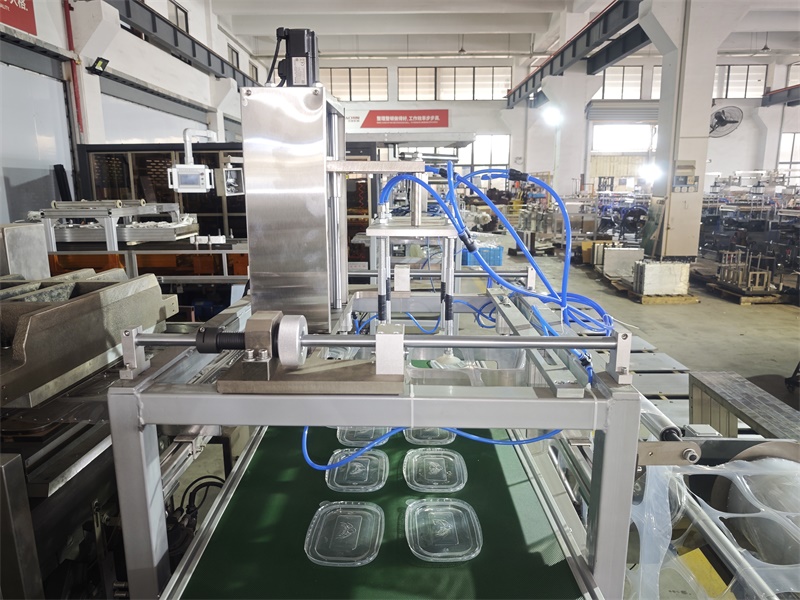
How Plug Assist Enhances Material Flow and Draw Ratio
Mechanism: Controlled Pre-stretching and Flow Direction Management
Plug assist actively pre-stretches the heated sheet before vacuum or pressure is applied. By contacting the material early, the plug redistributes wall thickness and guides polymer flow into deep draw areas—directing elongation toward the cavity’s base to prevent excessive thinning at corners. A 2023 study from the Society of Plastics Engineers found that optimized plug pre-stretching improves wall thickness uniformity by up to 35% compared to unassisted forming. The plug’s geometry, surface finish, and temperature profile are tuned to the sheet’s viscoelastic behavior, influencing how material slides and adheres. Synchronized timing ensures engagement just before the forming force initiates, creating a balanced strain field that reduces necking and tear initiation. This controlled flow direction also minimizes webbing and fold formation in complex geometries—yielding predictable, repeatable draws that use less material, lower scrap rates, and expand the viable draw ratio envelope.
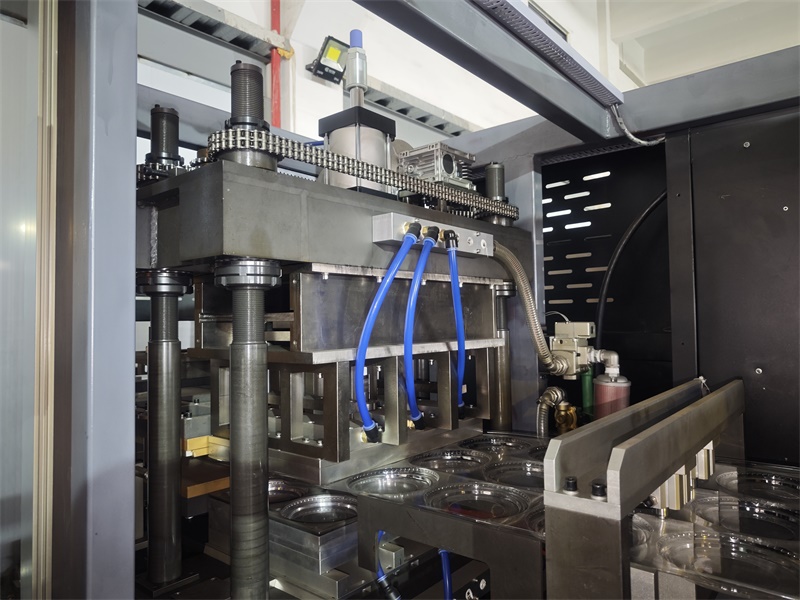
Impact on Draw Ratio: Case Evidence from Automotive Dashboard Production (6.5:1 DR, +32% vs. Non-Plug)
A leading automotive supplier achieved a 6.5:1 draw ratio for ABS dashboard skins using customized plug assist—32% higher than the 4.9:1 limit of their non-plug process. Without plug assistance, wall thinning exceeded 70% at critical radii, causing frequent cracking. With a contoured aluminum plug operating at 90–110°C and a gradient-controlled penetration speed, ultrasonic measurements confirmed minimum thickness retention above 0.8 mm—versus below 0.5 mm in identical regions without plug assist. This improved flow control enabled deeper drawing without strain localization, eliminating the need for multi-step processes or heavier-gauge starting sheets. The 6.5:1 benchmark set a new industry standard for automotive interior panels, reducing reject rates by 40% and cycle time by 12%, as reported in the Automotive Plastics Report 2024.
Minimizing Wall Thinning Through Plug Geometry and Timing Optimization
Geometry Effects: How Plug Profile Influences Strain Distribution and Minimum Thickness Retention
Plug profile governs initial contact area and strain distribution. Flat-tip plugs concentrate stress at the sheet apex, often triggering early localized thinning. In contrast, hemispherical or parabolic noses gradually expand the contact zone, spreading strain more evenly. Research from the Thermoforming Research Group (2023) demonstrated that switching from a flat to an elliptical plug on a 4:1 draw-ratio ABS part increased minimum wall thickness from 0.58 mm to 0.82 mm—a 41% improvement in retention. Elliptical profiles further reduce thickness variation by guiding material toward corners before full mold contact, preventing excessive thinning at the base radius. Computational modeling confirms that a plug radius-to-part-depth ratio of 1:1.2 consistently delivers the most uniform strain distribution, balancing pre-stretch and final forming forces.
Timing Strategy: Synchronizing Plug Engagement with Sheet Temperature and Vacuum Ramp
Precise coordination between plug entry, sheet core temperature, and vacuum onset is essential for wall uniformity. Engaging too early—while the surface exceeds the polymer’s softening point—causes drag-induced thin spots; engaging too late leaves the sheet too stiff for effective pre-stretch. A production case study on polycarbonate signage panels showed that delaying plug penetration by 0.4 s—allowing surface cooling to 148 °C—reduced thickness scatter from ±22% to ±9% without extending cycle time (Polymer Processing, 2022). Optimal performance occurs when vacuum ramping begins 0.2 s before plug retraction, enabling a seamless transition that locks in wall distribution while the sheet remains pliable. When combined with real-time IR pyrometer feedback, this timing-tuned approach allows manufacturers to sustainably maintain minimum wall thickness above 75% of the original sheet gauge—even at draw ratios exceeding 3:1.
Preventing Post-Form Distortion and Cracking via Thermal and Mechanical Control
Residual Stress Mitigation: Managing Thermal Gradients During Ejection and Cooling
Non-uniform cooling across the sheet thickness induces residual stresses that cause warpage and cracking after ejection. In plug-assisted deep draw thermoforming, managing thermal gradients is therefore central to dimensional stability. Controlled ejection—releasing the part once core and surface temperatures equalize within a 5°C window—minimizes differential contraction. Zoned cooling systems that keep mold halves within 10°C of one another, along with heated plug technology that prevents sudden skin solidification, have reduced distortion by up to 40% in industry trials. Post-form annealing or targeted forced-air cooling on the male side further balances heat extraction from both faces, preventing concave deflection. These strategies ensure crack-free, dimensionally stable parts—especially critical for high-draw-ratio components like automotive interior panels.
Selecting and Designing Effective Plug Assist Systems
Material Trade-offs: Aluminum, Steel, and Composite Plugs for Thermal Response, Durability, and Cycle Efficiency
Plug material selection directly affects heat transfer, wear resistance, and throughput. Aluminum plugs (thermal conductivity ~205 W/m·K) enable rapid sheet cooling and shorter cycles—ideal for high-volume, thin-gauge applications. Steel offers superior hardness and longevity (500,000–1,000,000+ cycles), particularly in abrasive, high-temperature environments, though its slower thermal response may extend cycle time by 15–20%. Advanced composites—such as syntactic foam or carbon-fiber blends—provide low density (<1.8 g/cm³), reduced inertial loads, and customizable thermal profiles that cut surface defects by up to 40% versus metal plugs (composite manufacturer data, 2023). Key trade-offs are summarized below:
| Material | Thermal Response | Durability (Cycles) | Typical Cycle Efficiency Gain |
|---|---|---|---|
| Aluminum | Fast heat transfer | ~300,000–500,000 | 10–15% shorter cycle |
| Steel | Moderate; requires pre-heat | 500,000–1,000,000+ | Baseline (longer cycle) |
| Composite | Customizable, low thermal mass | ~200,000–400,000 (varies) | Up to 20% faster than steel |
Selecting the optimal plug requires balancing thermal responsiveness against long-term durability and part quality—often necessitating prototyping with the specific sheet material and production conditions.
Frequently Asked Questions
What is plug assist in thermoforming?
Plug assist is a technique in thermoforming where a shaped plug is used to pre-stretch the heated plastic sheet before vacuum or pressure is applied. This helps control material flow, improve wall thickness uniformity, and allows for deeper draws.
What are the benefits of using plug assist?
Plug assist offers various advantages, such as reduced material usage, enhanced wall thickness uniformity, lower scrap rates, higher draw ratios, and improved part quality. It also minimizes webbing, fold formation, and the risk of cracking.
How does the shape of the plug impact material distribution?
The shape of the plug significantly influences strain distribution and wall thickness retention. Hemispherical, elliptical, or parabolic plug profiles are better for evenly distributing strain, preventing thinning at critical points, and improving structural integrity.
What are the best materials for plug assist systems?
Common materials used for plug assists include aluminum, steel, and advanced composites. Each material offers unique benefits: aluminum has efficient heat transfer, steel is highly durable, and composites provide lightweight options with customizable thermal properties.
How does timing affect plug-assisted thermoforming?
Precise coordination of plug engagement, sheet temperature, and vacuum timing is critical. Early or delayed plug engagement can result in material thinning or insufficient pre-stretch, affecting part quality.