
 EN
EN
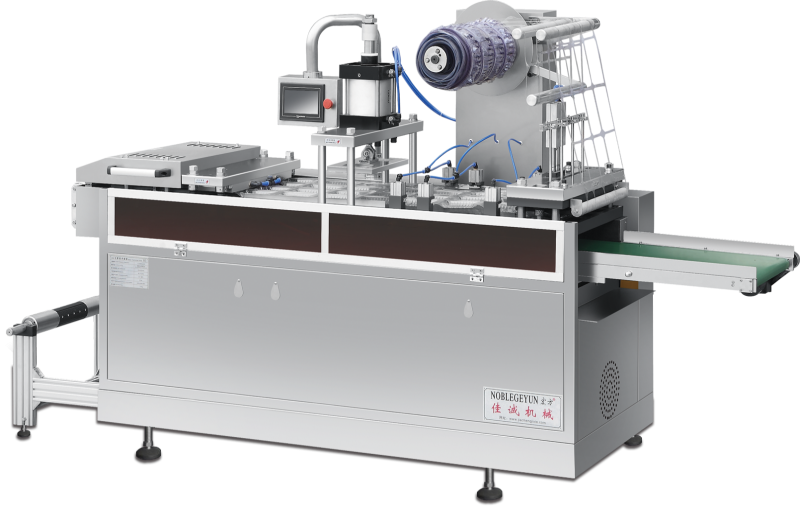
Core Types of Plastic Thermoforming Machines by Application
Roll-fed vs. inline thermoforming machines for high-speed tray and cup production
Roll-fed thermoforming machines process continuous plastic rolls, achieving outputs exceeding 30,000 parts/hour—ideal for standardized food trays and drink cups. Inline systems handle pre-cut sheets, offering greater flexibility for medium-batch runs with frequent design changes. Both configurations optimize cycle times through synchronized heating, forming, and trimming stages.
Cup-specific, tray-specific, and twin-sheet machines: throughput, precision, and part complexity trade-offs
Specialized thermoforming equipment targets distinct container needs. Cup formers prioritize rapid cycling (>40 cycles/minute) and micron-level thickness consistency for leak-proof seals. Tray machines emphasize dimensional stability to integrate seamlessly with automated filling lines, often incorporating robotic unloading. Twin-sheet systems enable complex geometries like double-walled containers but reduce throughput by 15–20% versus single-sheet alternatives.
| Machine Type | Throughput (units/hr) | Precision Tolerance | Part Complexity |
|---|---|---|---|
| Cup-Specific | 25,000–40,000 | ±0.1mm | Low |
| Tray-Optimized | 20,000–35,000 | ±0.2mm | Medium |
| Twin-Sheet | 8,000–15,000 | ±0.3mm | High |
Table: Performance trade-offs across specialized thermoforming equipment. Twin-sheet machines support intricate designs but sacrifice speed.
How Plastic Thermoforming Machines Execute the Production Process
Preheating, forming (vacuum/pressure), cooling, and trimming — machine-integrated process control
Plastic thermoforming machines transform polymer sheets into trays, cups, and containers through four synchronized stages. First, precision infrared heaters raise material temperature to 160–200°C—achieving optimal pliability without degradation. Next, the softened sheet contacts molds where vacuum, pressure, or mechanical force shapes it into food-safe geometries. Rapid cooling follows using chilled plates or air jets, solidifying parts within seconds while preserving dimensional accuracy. Finally, integrated servo trimmers remove excess material with ±0.2mm precision. Modern systems automate this sequence via closed-loop controls that dynamically adjust heating zones, pressure profiles, and dwell times—eliminating manual transfers and reducing defects by 18% compared to decoupled systems.
Cycle time optimization and repeatability: why machine synchronization matters for food-grade containers
For food packaging, consistent sub-3-second cycle times demand precise machine synchronization. Asynchronous operation causes temperature fluctuations that drive wall thickness deviations exceeding 12%, compromising structural integrity and seal reliability. Programmable logic controllers maintain phase alignment across preheating, forming, cooling, and trimming—ensuring mold indexing matches cooling durations to prevent premature demolding. This coordination delivers 99.8% repeatability for critical food-safety parameters like seal strength and dimensional tolerance. In high-speed operations producing 8,000+ units/hour, even 0.1-second timing errors can trigger jams affecting 15% of output.
Critical Machine Capabilities That Define Performance and Quality
Precision infrared heating, plug assist dynamics, and pressure box design for uniform wall thickness
Consistent material distribution is essential for structural integrity and material efficiency. Precision infrared heating enables ±0.5°C temperature control across the sheet surface—eliminating cold spots that cause localized thinning. Synchronized plug-assist dynamics, with variable-speed plugs reaching up to 500 mm/s, promote even stretching into deep cavities. Pressure boxes apply up to 6 bar during vacuum forming, compressing material tightly against mold contours. Together, these features maintain wall thickness tolerances within ±0.1mm and reduce material waste by 18% versus conventional methods.
Automation integration: servo-driven indexing, in-line vision inspection, and robotic stacking for trays and cups
End-to-end automation transforms discrete stations into cohesive production systems. Servo-driven indexing achieves ±0.05mm positional accuracy between stations—enabling reliable sub-4-second cycles for high-volume cup production. In-line vision systems perform over 200 dimensional checks per minute using high-resolution cameras, instantly flagging thickness deviations beyond ISO standards for food packaging. This reduces defects by 50% according to 2023 industry analysis. Six-axis robots with vacuum grippers handle delicate containers without deformation, palletizing up to 120 units per minute while eliminating contamination risks from manual handling.
Material and Tooling Compatibility in Industrial Plastic Thermoforming Machines
Material compatibility is foundational for optimizing plastic thermoforming machines, as polymers like PET, HDPE, and polypropylene require tailored thermal profiles and forming pressures. PET demands precise temperature control to avoid crystallinity issues; polypropylene’s low thermal conductivity necessitates extended heating zones. Tooling design directly influences outcomes: aluminum molds support rapid cooling for high-volume food containers, while cast tooling suits short runs of complex geometries. Material shrinkage rates—typically 0.5–3%—must align with mold tolerances to prevent warping in cups and trays. For recycled-content applications, machines require adjustable pressure curves to accommodate inconsistent melt flow, maintaining wall thickness uniformity required for FDA-compliant food packaging.
Ready to Match Your Thermoforming Machine to Your Production Goals?
Reliable, application-specific thermoforming machinery is the backbone of profitable food packaging manufacturing—no amount of process adjustment can compensate for misaligned equipment or substandard build quality. By selecting roll-fed, inline, cup-specific, tray-optimized, or twin-sheet machines tailored to your throughput, precision, and design complexity needs, you’ll unlock consistent, cost-effective production for OEM, contract, and private-label projects.
For industrial-grade plastic thermoforming machines engineered for global food safety compliance, or to receive expert guidance on configuring a custom line for your cup, tray, or specialty container needs, partner with a manufacturer rooted in decades of OEM and export experience. Jiacheng Machinery brings over 20 years of expertise in designing and building high-performance thermoforming equipment for manufacturers worldwide. Contact us today for a no-obligation consultation and customized solution quote to scale your thermoforming operations.
FAQs About Plastic Thermoforming Machines
What are roll-fed and inline thermoforming machines used for?
Roll-fed thermoforming machines are ideal for high-speed production of standardized items like food trays and drink cups. Inline machines, on the other hand, handle pre-cut sheets, making them more suitable for medium-batch runs and frequent design changes.
What are the advantages of twin-sheet thermoforming machines?
Twin-sheet systems allow for the production of complex geometries, such as double-walled containers. However, they come with reduced throughput compared to single-sheet alternatives.
How do thermoforming machines ensure wall thickness uniformity?
Uniform wall thickness is achieved through precision infrared heating, plug assist dynamics, and pressure box design, ensuring even material distribution and reducing waste.
What role does automation play in plastic thermoforming?
Automation enhances efficiency and quality by integrating servo-driven indexing, in-line vision inspection, and robotic stacking into the process, reducing human error and contamination risks.
Which materials are compatible with plastic thermoforming machines?
Common materials include PET, HDPE, and polypropylene. Each material requires specific thermal and pressure adjustments to ensure optimal results and prevent issues like warping or crystallinity.
Table of Contents
- Core Types of Plastic Thermoforming Machines by Application
- How Plastic Thermoforming Machines Execute the Production Process
- Critical Machine Capabilities That Define Performance and Quality
- Material and Tooling Compatibility in Industrial Plastic Thermoforming Machines
- Ready to Match Your Thermoforming Machine to Your Production Goals?
-
FAQs About Plastic Thermoforming Machines
- What are roll-fed and inline thermoforming machines used for?
- What are the advantages of twin-sheet thermoforming machines?
- How do thermoforming machines ensure wall thickness uniformity?
- What role does automation play in plastic thermoforming?
- Which materials are compatible with plastic thermoforming machines?