
 EN
EN
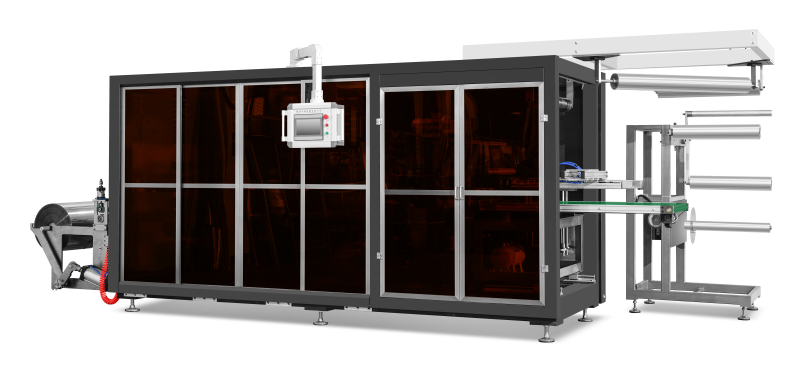
Production Capacity and Cycle Time: How Station Count Directly Drives Output
Cycle time fundamentals: Why single-station systems max out at ~1,200 cycles/hour—and how multi-station configurations scale linearly
A single-station thermoformer executes heating, forming, cooling, and ejection sequentially—so total cycle time equals the sum of all phase durations. Thermal recovery limits and material-handling lag cap sustainable output at approximately 1,200 cycles per hour. This sequential architecture inherently constrains throughput for high-volume production. Multi-station systems eliminate that bottleneck by distributing tasks across dedicated, independent stations. Because operations run in parallel, output scales nearly linearly with station count: a two-station system achieves ~2,000 cycles/hour; a four-station unit exceeds 4,800. Crucially, throughput is governed not by the sum of steps—but by the longest individual step, aligning with core manufacturing line-balancing principles and enabling predictable, scalable SingleStation MultiStation Production Capacity.
Real-world throughput benchmarks: ISO-certified facility data comparing 1-, 2-, 3-, and 4-station thermoformers at sustained 8-hour runs
Data from sustained 8-hour production runs at an ISO-certified facility—using standardized 4-cavity tools for a common polypropylene food container—confirms this direct relationship between station count and output:
| Station Configuration | Sustained Output per 8-Hour Shift* | Approximate Annualized Volume** |
|---|---|---|
| Single-Station | 8,000–9,600 units | ~2.4 million |
| Two-Station | 16,000+ units | >4.8 million |
| Three-Station | ~32,000 units | ~9.6 million |
| Four-Station | 36,000+ units | >10.8 million |
*Accounts for standard downtime; **Assumes 300 operating days
A single-station machine producing ~9,200 units/day faces diminishing returns beyond ~2.5 million annual parts—not just from capacity limits, but from escalating spatial, labor, and coordination overhead when scaling via duplication. In contrast, a four-station system’s 36,000+ daily output provides the only economically viable path for contracts exceeding 10 million units/year—validating linear scalability in real-world conditions.
Technical Architecture: Heating, Forming, and Staging Differences That Impact SingleStation and MultiStation Performance
Thermal management contrast: Single-zone precision vs. station-specific zone tuning for consistent part quality
Thermal control is the most consequential architectural difference between single- and multi-station systems—and the primary driver of quality consistency at scale. Single-station machines rely on one heating zone for the entire sheet, requiring broad calibration that often sacrifices edge-to-center uniformity. While acceptable for thin-gauge materials (<1.5 mm), this limitation becomes critical with thicker sheets (>3 mm), where temperature variance contributes to warpage, wall-thickness inconsistency, and higher scrap rates.
Multi-station systems resolve this through station-specific thermal zoning. Each station features independently controlled heating elements—often segmented into pre-heat, main-form, and stabilization zones—enabling precise, recipe-driven profiles calibrated per material and part geometry. One leading manufacturer’s three-station platform maintains ±2°C zone accuracy across infrared banks, ensuring optimal sheet temperature before mold contact. This level of control is essential for engineered resins like polycarbonate or high-impact polystyrene, where quality hinges on staying within a narrow 5°C thermal window. The result is stable, shift-to-shift part quality—even amid ambient plant fluctuations.
Process synchronization: Modular station independence versus sequential dependency in single-station thermoforming
Synchronization strategy defines where bottlenecks form—and how efficiently capacity is utilized. Single-station systems enforce rigid sequence dependency: heating must finish before forming begins, forming before cooling, and cooling before trimming. Any delay in one stage idles all others—deep-draw parts requiring extended cooling, for example, leave heaters and trimmers idle, dragging down overall equipment effectiveness (OEE).
Multi-station systems replace sequence with parallelism. Heating, forming, cooling, and trimming occur simultaneously across physically separate stations, each advancing at its own optimized pace. As one station heats the next sheet, another forms the current batch, and a third cools the prior one—creating continuous flow. Throughput is limited only by the longest station cycle, not the sum of all stages. Advanced PLCs coordinate inter-station transfers with sub-millisecond timing, eliminating hesitation and cascading delays. This architecture unlocks sustained throughput gains without overloading individual subsystems.
Automation, Changeover, and SKU Flexibility: Operational Agility Across SingleStation and MultiStation Systems
Tool change economics: 45–90 minutes (single-station) vs. <8 minutes with robotic auto-tooling (multi-station)
Tool change time directly impacts operational agility and effective production capacity. On single-station thermoformers, manual tool swaps take 45–90 minutes—halting output and demanding skilled labor. In contrast, multi-station systems equipped with robotic auto-tooling complete changeovers in under eight minutes using automated clamping, pre-loaded recipes, and no-touch alignment. For facilities running multiple short-run SKUs, this translates to over 50 recovered minutes per job—time that boosts OEE, enables true just-in-time delivery, and supports high-mix, low-volume production without sacrificing cost efficiency. Robotic auto-tooling isn’t just faster—it’s a strategic enabler of responsive, customer-centric manufacturing.
Total Cost of Ownership: Balancing Upfront Investment Against Long-Term Production Capacity Gains
CAPEX vs. cost-per-part analysis: When multi-station thermoformers deliver ROI—using Plastics Industry Association 2024 TCO modeling
Sticker price alone misrepresents value. While single-station systems carry lower initial CAPEX, their throughput ceiling drives up cost-per-part as volume increases. The Plastics Industry Association’s 2024 TCO model—which incorporates acquisition, tooling, labor, energy, and downtime over a 10-year horizon—shows that a four-station thermoformer, despite 40–50% higher upfront investment, delivers 15–20% lower cost-per-part once annual output exceeds 1.5 million units. This advantage stems from parallel staging, reduced cycle time per part, and shared utility infrastructure—trimming per-part energy use by ~12%. At 3 million parts/year, the multi-station line’s total ownership cost falls below that of equivalent single-station capacity, with typical payback achieved within 18 months. Manufacturers optimizing for long-term production capacity and ROI must prioritize lifecycle economics—not just initial purchase price.
FAQ
What limits the cycle time of single-station systems?
Single-station systems are limited by their sequential operation, where heating, forming, cooling, and ejection must occur one after the other. This architecture naturally caps throughput at around 1,200 cycles/hour due to thermal recovery limits and material-handling lag.
How do multi-station systems achieve higher output?
Multi-station systems distribute tasks across independent, dedicated stations, enabling parallel operations. Heating, forming, cooling, and trimming occur simultaneously, with output scaling nearly linearly based on the number of stations.
What's the advantage of station-specific thermal zoning?
In multi-station systems, station-specific thermal zoning ensures precise heating tailored to materials and part geometry. This improves part quality and consistency while minimizing issues like warpage or wall-thickness inconsistency.
How does automation improve changeover times?
Automation, such as robotic auto-tooling, reduces tool change times from 45–90 minutes on single-station systems to less than eight minutes in multi-station systems. This enables facilities to handle more short-run SKUs with increased efficiency.
When do multi-station thermoformers achieve ROI?
Based on the Plastics Industry Association’s 2024 TCO model, multi-station systems achieve ROI within 18 months for annual outputs exceeding 1.5 million units, thanks to lower cost-per-part and improved efficiency.
Table of Contents
- Production Capacity and Cycle Time: How Station Count Directly Drives Output
- Technical Architecture: Heating, Forming, and Staging Differences That Impact SingleStation and MultiStation Performance
- Automation, Changeover, and SKU Flexibility: Operational Agility Across SingleStation and MultiStation Systems
- Total Cost of Ownership: Balancing Upfront Investment Against Long-Term Production Capacity Gains
- FAQ