
 EN
EN
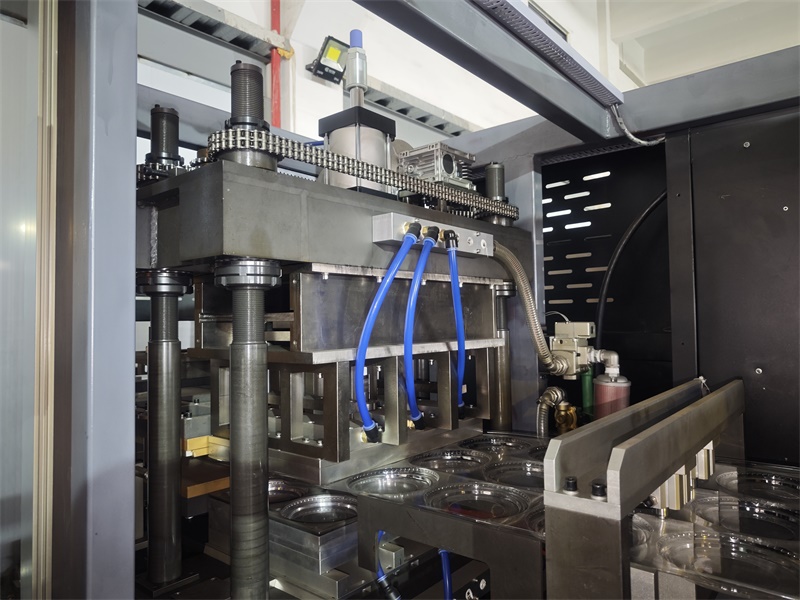
The Five-Phase Cycle: Diagnosing Bottlenecks for Targeted Cycle Time Reduction
Effective cycle time reduction in high-speed production efficiency begins with a clear breakdown of the thermoforming sequence. Understanding how heating, forming, cooling, ejection, and reset interact reveals where delays accumulate—and where targeted improvements deliver the greatest throughput gains.
Heating–Forming–Cooling–Ejection–Reset: How Each Phase Contributes to Total Cycle Time
A consistent heater-bank response sets the pace, but variability often appears as the sheet absorbs energy unevenly. Forming relies on rapid vacuum or pressure application, yet its duration is usually fixed by part geometry. Cooling solidifies the shape and can occupy 40–60% of the total cycle; even a few extra seconds here disproportionately extend the cycle. Ejection and reset involve tool movement and material clearance—small mechanical lags that compound when unmonitored. Mapping each phase’s time share identifies the true constraint, often hidden not in the slowest single step but in the interaction between phases.
Why Cooling and Ejection Dominate Variability in High-Speed Production Efficiency
Cooling is highly sensitive to mold temperature fluctuations, material thickness, and ambient conditions—making it the primary source of cycle-time scatter. Even a 1°C deviation in mold surface temperature can shift solidification time by several tenths of a second per cycle. Ejection introduces additional uncertainty: part sticking, delayed sensor signals, or inconsistent release timing frequently disrupt steady-state rhythm. Since these two phases are directly influenced by thermal and mechanical variables that shift across shifts and material lots, they account for over 70% of observed cycle-time variability. Stabilizing cooling and ejection therefore yields the fastest, most repeatable gains in overall line speed.
Tooling & Thermal Management: Accelerating Cooling and Reset for High-Speed Production Efficiency
Conformal Cooling Channels vs. Conventional Tooling: Quantified Gains in Solidification Rate
Conformal cooling channels—manufactured via additive techniques—follow the exact contour of the formed part, delivering uniform heat extraction impossible with conventional gun-drilled straight lines. Research demonstrates that these 3D-printed inserts reduce cooling time by 25–40%, directly shortening the solidification phase and boosting high-speed production efficiency. In practice, a 1.5–2 second saving per cycle accumulates to thousands of extra parts per shift. The even temperature profile also reduces warpage and residual stress, raising part consistency. Integrating conformal channels into existing tools often demands retrofitting the mold base, but the rapid heat transfer consistently lowers overall cycle time reduction targets without compromising quality.
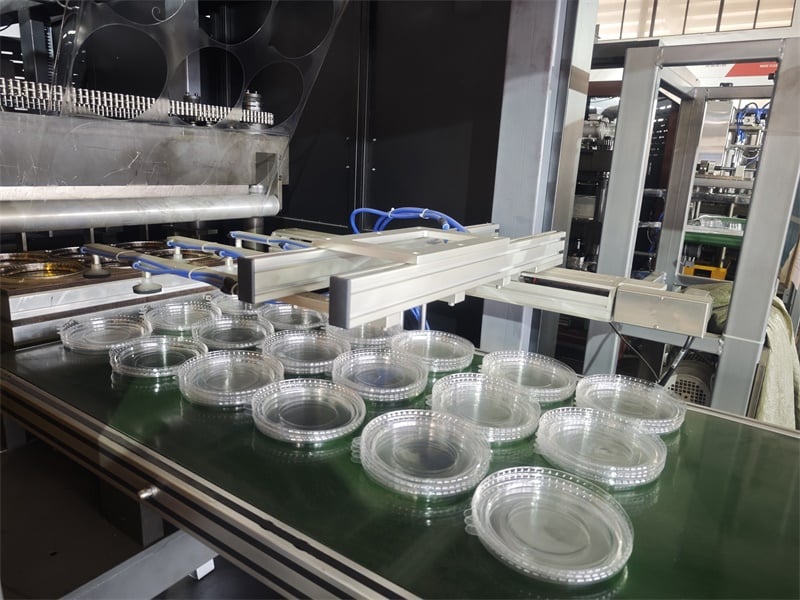
Material Selection Trade-Offs: Aluminum, Steel, and Composite Tooling Impact on Thermal Mass and Cycle Stability
Tooling material governs heat flow and process robustness. The table below compares common choices for high-speed thermoforming.
| Material | Thermal Conductivity (W/m·K) | Thermal Mass Impact | Cycle Stability | Typical Application |
|---|---|---|---|---|
| Aluminum (7075/6061) | ~150–200 | Low – heats and cools rapidly | Good for short to medium runs; susceptible to wear | Thin-gauge packaging, high-volume where tight cycles matter |
| Tool steel (P20/H13) | ~30–50 | High – retains heat longer | Excellent, consistent over millions of cycles | Abrasive or high-melt-temperature polymers, precision parts |
| Carbon-fiber composite | ~10–50 (anisotropic) | Very low – ultrafast thermal response | Limited by temperature ceiling (~150 °C) | Prototypes, low-volume fast-cycle jobs |
Aluminum alloys enable a 20–25% cycle time reduction over steel because of their lower thermal mass—an advantage in fast-paced production lines. Steel, by contrast, stabilizes thermal variation across long runs, critical for maintaining high-speed production efficiency when material lots change. Composite tooling offers the quickest temperature swing but demands tight process controls to avoid degradation. Selecting the right material requires balancing immediate solidification gains against long-term cycle stability and maintenance costs.
Scientific Process Optimization: Data-Driven Parameter Tuning for Sustainable Cycle Time Reduction
Achieving sustainable cycle time reduction in high-speed thermoforming operations demands a rigorous, data-driven approach to process parameter tuning.
DOE-Based Calibration of Temperature–Pressure–Dwell Interdependencies
Design of experiments (DOE) systematically maps the nonlinear interactions among temperature, pressure, and dwell time, replacing costly trial-and-error with statistical rigor. A properly constructed factorial design reveals which factor combinations most influence solidification rate and part integrity. By isolating second-order effects, engineers can identify the narrow process window that minimizes overall cycle time without sacrificing quality. In a comparable manufacturing scenario, data-driven DOE calibration delivered a 17.64% reduction in process cycle time. When applied to high-speed thermoforming, such optimization directly shortens heating and cooling phases while maintaining dimensional accuracy, laying the foundation for repeatable production efficiency gains.
Real-Time Adaptive Control Integration: Maintaining Consistency Across Shifts and Material Lots
Even with optimized setpoints, raw-material variation and environmental drift can cause gradual shifts in part quality. Real-time adaptive control integrates in-line sensors and machine-learning algorithms to dynamically adjust temperature, pressure, or dwell during every cycle. This closed-loop feedback preemptively corrects deviations before they generate scrap. Advanced implementations have demonstrated a 30% improvement in product consistency across large production runs. By automatically compensating for batch-to-batch resin viscosity or ambient temperature changes, adaptive systems sustain high-speed production efficiency and lock in the cycle-time gains achieved during DOE calibration, shift after shift.
Automation Strategy: Prioritizing ROI-Positive Upgrades for High-Speed Thermoforming
To achieve meaningful cycle time reduction and sustain high-speed production efficiency, manufacturers must target automation upgrades that deliver rapid, measurable returns. Two areas where modest investment repeatedly yields double-digit gains are robotic part handling and intelligent ejection.
Robotic Loading/Unloading: Reducing Manual Intervention Without Compromising Part Quality
Robotic loading and unloading eliminate the variability that comes with manual material placement. High-speed pick-and-place systems, guided by precision sensors, position sheets consistently within ±0.2 mm, ensuring uniform heating and forming. This repeatability not only shortens loading windows by up to 40% but also prevents the part distortion and surface defects that occur when operators handle hot, still-soft parts. Freed from repetitive manual tasks, staff can focus on inspection and line monitoring, while robots maintain the relentless pace required by modern trim-in-place tools without a corresponding rise in defect rates.
Smart Ejection Systems: Cutting 1.8 Seconds per Cycle While Lowering Scrap by 11%
Replacing fixed ejection strokes with adaptive, sensor-driven systems saves an average of 1.8 seconds per cycle and lowers scrap by 11%. Smart ejectors use force feedback and mold-release sensors to modulate ejection force in real time. They gently dislodge parts the instant adhesion weakens, avoiding the micro-cracks and distortion that lead to downstream rejects. By synchronizing ejection with the exact cooling completion point, these systems eliminate the safety-margin delays typical of timer-based approaches—squeezing seconds from the most variable phase of the cycle while preserving part integrity.
FAQ
What are the five phases of the thermoforming cycle?
The five phases are heating, forming, cooling, ejection, and reset, each contributing to the total cycle time and potential bottlenecks in production.
Why is cooling such a critical phase?
Cooling typically occupies 40–60% of the total cycle time and is highly sensitive to mold temperature, material thickness, and ambient conditions, making it a significant source of variability.
How do conformal cooling channels improve cycle time?
Conformal cooling channels reduce cooling time by 25–40% by delivering uniform heat extraction, boosting production efficiency without compromising part quality.
What role does data-driven optimization play in cycle time reduction?
Design of experiments (DOE) and real-time adaptive controls enable precise parameter tuning and consistent production efficiency by minimizing variability across shifts and material lots.
How can automation strategies enhance high-speed thermoforming?
Automation strategies like robotic loading/unloading and smart ejection systems reduce cycle times and scrap rates, delivering measurable ROI and sustained throughput improvements.
Table of Contents
- The Five-Phase Cycle: Diagnosing Bottlenecks for Targeted Cycle Time Reduction
- Tooling & Thermal Management: Accelerating Cooling and Reset for High-Speed Production Efficiency
- Scientific Process Optimization: Data-Driven Parameter Tuning for Sustainable Cycle Time Reduction
- Automation Strategy: Prioritizing ROI-Positive Upgrades for High-Speed Thermoforming
- FAQ