
 EN
EN
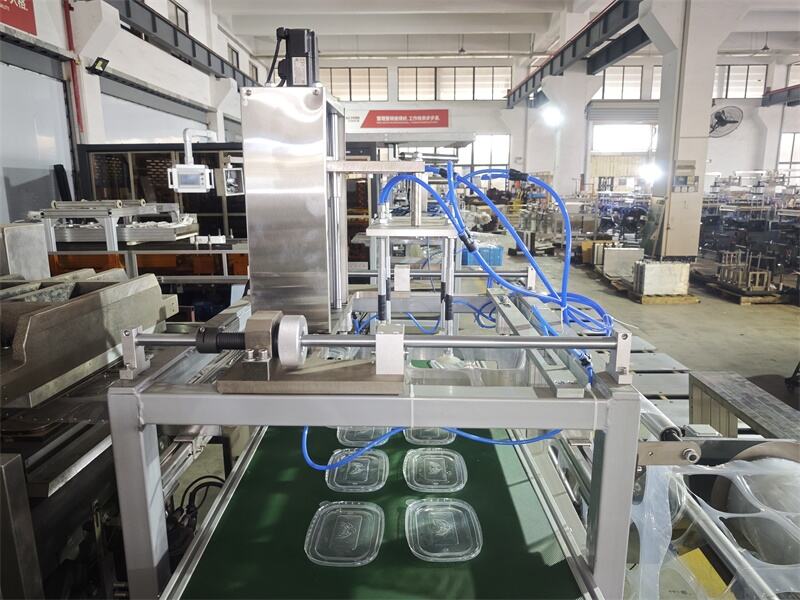
How Plastic Thermoforming Machines Work: Core Process and Key Components
The 5-Stage Thermoforming Cycle Explained
All plastic thermoforming machines follow a consistent, repeatable 5-stage production cycle to shape thermoplastic sheets into finished parts. First, the flat sheet is clamped securely in the machine’s frame. Next, it’s heated—typically using calibrated infrared heaters—to a precise, uniform temperature that renders the material pliable without degradation. The softened sheet then moves to the forming station, where vacuum pressure, positive air pressure, or mechanical force presses it against a mold to capture the desired geometry. After forming, controlled cooling solidifies the part’s shape and dimensional stability. Finally, excess material is trimmed—either inline or as a secondary operation—to meet exact specifications. This standardized cycle ensures repeatability and quality across production runs of any scale.
Critical Machine Components: Heating, Forming, and Trimming Systems
Three core systems define a thermoforming machine’s capability and output quality. The heating system must deliver uniform thermal energy across the sheet surface; uneven heating causes thinning, warping, or incomplete mold contact, so modern systems rely on digitally tuned infrared emitters with zone-specific temperature control. The forming system applies controlled force to shape the softened sheet, with vacuum forming suited for shallow parts, pressure forming for deeper draws and finer detail, and mechanical stamping for high-precision, low-draft geometries. The trimming system, when integrated, removes flash and finishes edges directly in-cycle—reducing manual labor and improving throughput, especially in high-volume applications (Industrial Manufacturing Association, 2024).
Types of Plastic Thermoforming Machines for Industrial Use
Manual, Semi-Automatic, and Fully Automatic Machines
Plastic thermoforming machines are categorized by automation level to match operational scale, budget, and labor strategy. Manual machines require operator intervention at every stage—loading, heating, forming, cooling, and trimming—and are best suited for prototyping, low-volume custom work, or specialty parts where flexibility outweighs speed. Semi-automatic machines automate heating and forming while leaving part removal or trimming to operators, offering a practical balance for medium-run production with moderate capital investment. Fully automatic machines integrate sheet feeding, forming, cooling, trimming, and part stacking—enabling unattended operation, consistent output, and lower per-unit labor costs in high-volume manufacturing environments.
Twin-Sheet vs. Single-Sheet Thermoforming Machines
Single-sheet thermoforming uses one heated plastic sheet per cycle and dominates applications requiring thin-walled, shallow-depth parts—such as food trays, blister packaging, and consumer product housings. Its advantages include lower tooling costs, faster setup, and shorter cycle times. Twin-sheet thermoforming, by contrast, simultaneously forms and bonds two separate heated sheets to create hollow, rigid, three-dimensional structures—ideal for industrial enclosures, pallets, tanks, and recreational equipment. While twin-sheet systems demand higher initial investment and more complex mold design, they deliver structural integrity and weight efficiency unmatched by single-sheet processes.
Key Selection Criteria for Plastic Thermoforming Machines
Material Compatibility, Part Size, and Production Volume Requirements
Selecting the right machine begins with matching technical capabilities to application demands. Material compatibility is foundational: verify the machine supports your target thermoplastics (e.g., PET, PVC, ABS, polystyrene) and can accommodate required sheet gauges—from thin 0.010" films to thick 0.500" panels—without overheating or under-softening. Forming area must exceed your largest part’s footprint—including necessary clamping margins—to prevent edge distortion or incomplete draw. Finally, production volume dictates automation level: manual or semi-automatic units suffice for batches under 1,000 units/month, while fully automatic systems become cost-effective above 10,000 units/month due to labor savings and uptime consistency.
Precision, Repeatability, and Integration with Automation
For mission-critical or regulated applications, precision and repeatability are non-negotiable. Machines equipped with digital temperature profiling, closed-loop position sensors, and servo-controlled mold movement reduce dimensional variation and scrap rates by up to 15% (Industrial Equipment Benchmark Report, 2026). Equally important is automation readiness: over 25% of manufacturers now prioritize seamless integration with existing factory systems—including robotic part handling, CNC trim stations, and MES/ERP platforms (Industry Automation Survey, 2026). Confirm the machine’s control architecture (e.g., EtherNet/IP, OPC UA) supports real-time data exchange and remote diagnostics to avoid bottlenecks and future-proof your production line.
Real-World Applications Across High-Demand Industries
Plastic thermoforming machines support diverse, high-value applications across multiple sectors. In packaging, they produce custom-fit blister packs, clamshells, and protective trays for electronics, pharmaceuticals, and fresh foods—offering rapid turnaround and lower tooling investment than alternatives like injection molding. The automotive industry relies on thermoforming for large interior components—including door panels, dash inserts, and bumper fascias—where lightweight, cost-effective parts are needed for low- to medium-volume production runs. Medical device manufacturers use certified systems to fabricate sterile barrier packaging, disposable instrument trays, and patient-specific orthotic shells—meeting ISO 13485 and FDA requirements for material traceability and process validation. In consumer goods, applications span refrigerator liners, playground equipment, retail displays, and appliance housings—leveraging thermoforming’s versatility for both aesthetics and functionality. With the global thermoformed industrial parts market projected to surpass $50 billion by 2027 (Grand View Research, 2024), demand continues to grow for machines that combine precision, scalability, and regulatory compliance.
FAQ
What is the difference between single-sheet and twin-sheet thermoforming?
Single-sheet thermoforming uses one plastic sheet per cycle to produce thin-walled, shallow-depth parts, while twin-sheet thermoforming simultaneously molds and fuses two sheets for creating hollow, rigid structures ideal for industrial or heavy-duty applications.
How does a fully automatic thermoforming machine benefit high-volume production?
Fully automatic machines streamline the entire production cycle, from feeding and forming to cooling and trimming, reducing labor costs and ensuring consistent output quality, making them ideal for large-scale manufacturing.
Why is precision critical in thermoforming machines?
Precision ensures dimensional accuracy and repeatability, reducing scrap and improving quality control, which is essential for mission-critical applications like medical devices or automotive parts.
What industries rely heavily on thermoforming machines?
Industries like packaging, automotive, medical devices, and consumer goods use thermoforming machines for their versatility, cost-effectiveness, and ability to meet varied production needs.
What factors should I consider when selecting a thermoforming machine?
Consider material compatibility, forming area size, production volume, precision requirements, and integration capabilities when choosing a thermoforming machine for your application.
Table of Contents
- How Plastic Thermoforming Machines Work: Core Process and Key Components
- Types of Plastic Thermoforming Machines for Industrial Use
- Key Selection Criteria for Plastic Thermoforming Machines
- Real-World Applications Across High-Demand Industries
-
FAQ
- What is the difference between single-sheet and twin-sheet thermoforming?
- How does a fully automatic thermoforming machine benefit high-volume production?
- Why is precision critical in thermoforming machines?
- What industries rely heavily on thermoforming machines?
- What factors should I consider when selecting a thermoforming machine?